

The Bench Press Guide
|
|
Time to read 4 min
|
|
Time to read 4 min
The bench press is one of the most commonly performed and most poorly executed exercises in strength training. A benchmark movement for developing the chest, triceps, and upper-body strength, it requires precise technique to be both effective and safe. Grip width, bar path, and scapular stability are variables documented by electromyography that directly influence muscle recruitment and injury risk.
This guide details optimal execution technique, the variables that truly influence muscle activation according to scientific research, the most common mistakes, and the main variations of the movement.
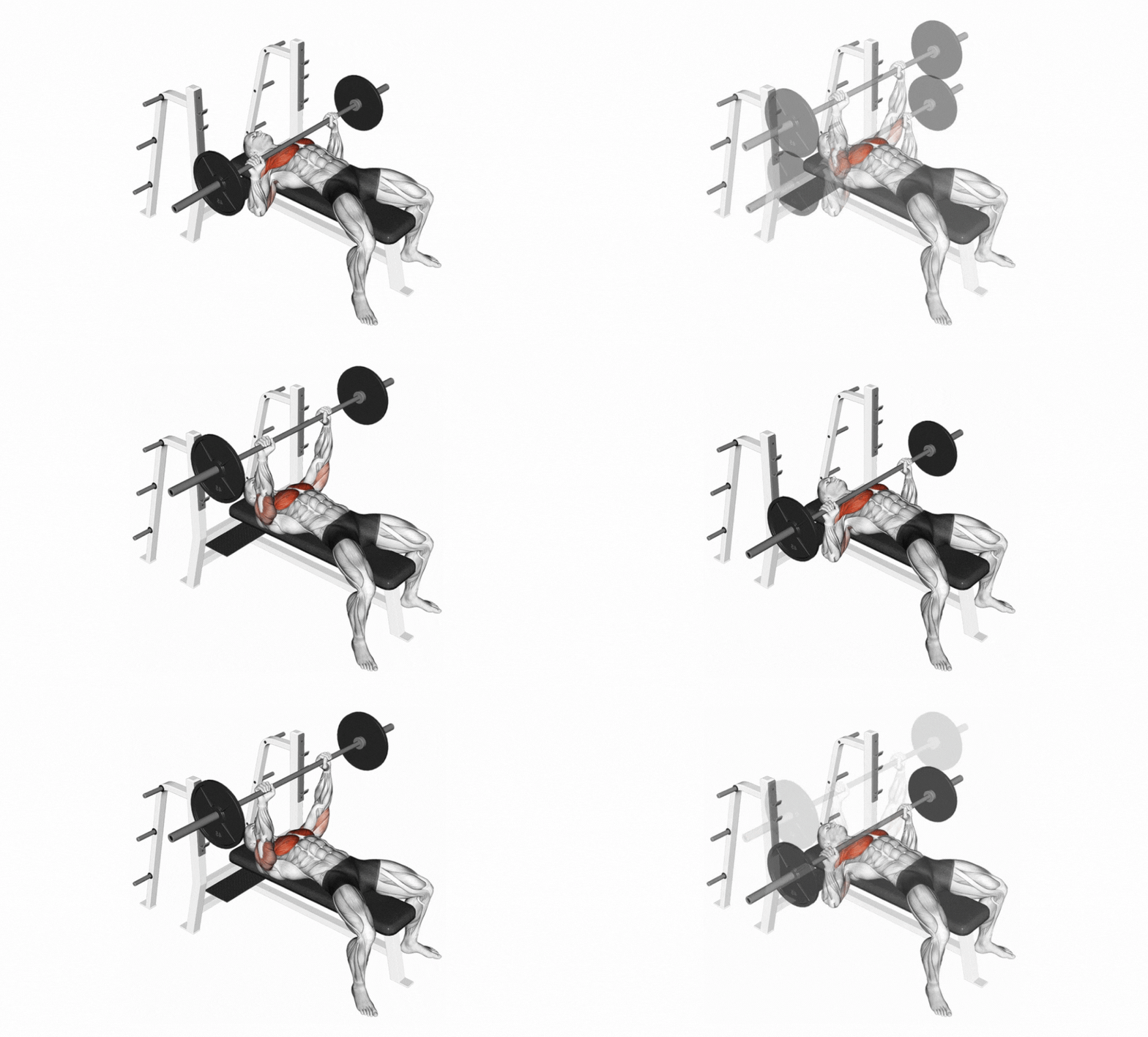
The bench press is a compound movement that recruits several muscle groups simultaneously, with varying contributions depending on the muscle portion and phase of the movement.
Proper technique maximizes muscle recruitment while protecting the shoulder and wrist joints.
Lehman (2005, Journal of Strength and Conditioning Research) measured the myoelectric activity of the pectoralis major, triceps, and biceps across five bench press variations with different grip widths. The results show that a narrower grip increases triceps activity and decreases activity in the sternoclavicular portion of the pectoralis major compared with a wider grip. The author concludes that, because the variations are relatively modest, grip-width selection should primarily be guided by joint comfort and sport-specific needs rather than the pursuit of precise muscle isolation.
Calatayud et al. (2017, Perceptual and Motor Skills) also examined the effect of grip width (100 %, 150 % and 200 % of biacromial distance) combined with attentional focus on the EMG activity of the pectoralis major and triceps. Their results suggest that an internal focus on the target muscle may slightly increase its activation (4 to 6 %) — supporting the value of mentally focusing on the muscle being worked during execution.
A narrower grip increases triceps work and slightly reduces chest work; a wider grip does the opposite. As these variations are moderate, joint comfort and goal specificity should take priority over searching for a universal "perfect" grip.
| Variation | Primary target muscle | Key feature |
|---|---|---|
| Wide-grip bench press | Pectoralis major | Reduced range of motion, potentially heavier load |
| Close-grip bench press | Triceps brachii | More demanding on the wrists and elbows |
| Dumbbell bench press | Pectoralis major + stabilizers | More natural range of motion, increased stabilizer recruitment |
| Incline bench press | Clavicular head (upper chest) | Bench angle of 30 to 45° |
Support your strength and recovery with suitable sports nutrition.
The bench press remains a fundamental exercise for developing upper-body strength and muscle mass. Grip width moderately influences the distribution of work between the chest and triceps according to electromyographic data, but joint comfort and technical stability remain more important than the search for a universal "optimal" grip.
Mastered technique — retracted shoulder blades, controlled bar path, and consistent progressive overload — combined with suitable nutrition is an effective combination for making lasting progress with this movement. Find all the supplements selected to support your training at Force Addict Pro.
Retrouvez les réponses aux questions les plus courantes avant votre achat.
Non, le développé couché sollicite principalement les pectoraux (grand pectoral), mais aussi fortement les triceps brachiaux, les deltoïdes antérieurs, les muscles fixateurs des omoplates et le gainage. C'est un mouvement polyarticulaire complet pour le haut du corps.
1 à 2 fois par semaine suffit pour la majorité des pratiquants. Selon les travaux de Schoenfeld publiés dans le Journal of Sports Sciences, un volume hebdomadaire plus élevé peut favoriser l'hypertrophie à condition que la récupération soit adéquate.
Pour l'hypertrophie musculaire, une fourchette de 6 à 12 répétitions est très efficace. Les séries de 3 à 6 répétitions sont davantage orientées force. Un repos de 90 à 180 secondes entre séries est recommandé selon l'intensité.
Les raisons les plus fréquentes sont : omoplates non serrées, charge trop lourde, coudes trop ouverts ou descente non contrôlée. Réduisez la charge, ralentissez la descente (2-3 secondes) et concentrez-vous sur la connexion muscle-esprit pour améliorer les sensations.
Non, à condition de bien l'exécuter. Les douleurs épaules apparaissent généralement lorsque les omoplates sont relâchées, les coudes trop ouverts ou la charge excessive. Un bon placement des omoplates et des coudes légèrement rentrés protège efficacement les épaules.
La créatine monohydrate est le complément le mieux documenté pour soutenir les efforts courts et intenses comme les séries lourdes. Une whey protéine complète ensuite l'apport en acides aminés nécessaires à la reconstruction musculaire post-entraînement.