

Barbell Incline Bench Press Execution Guide
|
|
Time to read 4 min
|
|
Time to read 4 min
The barbell incline bench press is one of the most effective exercises for targeting the upper portion of the chest. Widely used in strength training to build a fuller, more balanced chest, it places greater emphasis on the clavicular head of the pectoralis major — provided you choose the right bench angle, a variable whose impact is now precisely documented through electromyography.
This guide details the execution technique, the optimal bench angle according to scientific research, common mistakes, and how to incorporate this movement into a complete chest routine.
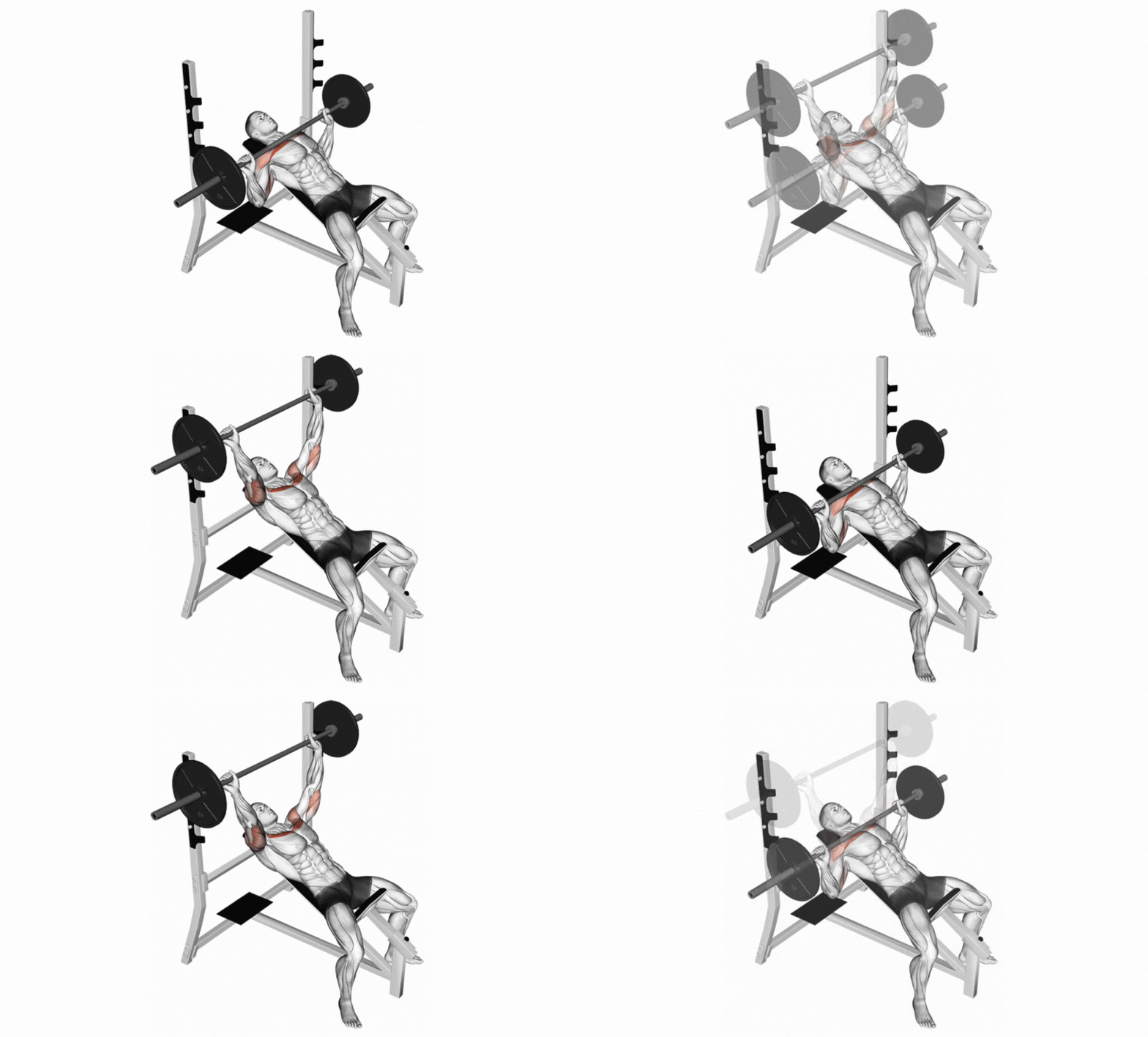
Quick answer: an angle between 30° and 45° offers the best balance — 44° maximizes documented upper chest activation, but beyond 45-50° the movement gradually shifts toward shoulder work rather than chest work.
Trebs et al. (2010, Journal of Strength and Conditioning Research) compared the electromyographic activation of the clavicular head and sternocostal head of the pectoralis major, as well as the anterior deltoid, at four bench angles: 0°, 28°, 44° and 56°. The results show that activation of the clavicular head was significantly higher at 44° compared with 0° and 28°, while anterior deltoid activation progressively increased with the angle. The authors conclude that it is necessary to alternate between flat and incline pressing to optimally recruit the entire chest musculature.
Lauver et al. (2015, European Journal of Sport Science) qualified these findings by analyzing muscle activation during different phases of the movement at 0°, 30°, 45° and -15°. While overall upper chest activation did not differ significantly between angles across the entire concentric phase, the 30° and 45° angles produced greater activation during a specific portion of the movement (26 to 50% of the contraction), while the lower chest was engaged more at flat and -15° angles than at 45°.
An angle between 30 and 45 degrees offers the best balance between upper chest activation and limiting stress on the shoulders. For complete development, alternate flat and incline pressing rather than limiting yourself to a single angle.
Set the bench to approximately 30 to 45 degrees depending on your goal. Squeeze your shoulder blades together and lower them slightly before lifting the bar from the rack. Lower the bar in a controlled manner toward the upper chest, without bouncing. Keep the elbows slightly tucked throughout the movement, without flaring them excessively.
| Bench angle | Primary activation | Key feature |
|---|---|---|
| 0° (flat) | Sternocostal head | Maximum overall chest activation |
| 28-30° | Clavicular head | Good upper chest / shoulders compromise |
| 44-45° | Clavicular head (maximum) | Highest documented activation |
| 56° and above | Anterior deltoid | Shifts toward a shoulder press |
Support your strength and recovery with sports nutrition suited to your pushing workouts.
The barbell incline bench press is a major exercise for targeting the upper chest. According to electromyographic data, a bench angle between 30 and 45 degrees provides the most effective activation of the clavicular head while limiting the shift in work toward the shoulders; beyond 56 degrees, the movement becomes closer to a shoulder press than targeted chest work.
For balanced development of the entire pectoralis major, alternate flat and incline pressing rather than favoring a single angle. Find all the supplements selected to support your training at Force Addict Pro.
Retrouvez les réponses aux questions les plus courantes avant votre achat.
Un angle de 30 degrés est le meilleur compromis pour la majorité des pratiquants. Il cible efficacement le faisceau claviculaire (haut des pectoraux) sans transférer trop de tension sur les deltoïdes antérieurs. Au-delà de 45 degrés, l'exercice se rapproche d'un développé épaules.
Oui, selon une étude publiée dans le Journal of Strength and Conditioning Research, l'angle incliné augmente l'activation du faisceau claviculaire du grand pectoral. C'est l'exercice de référence pour développer la hauteur et la densité du haut de poitrine.
L'inclinaison est probablement trop élevée, ou vos omoplates ne sont pas suffisamment fixées. Réduisez l'angle du banc, serrez les omoplates avant de sortir la barre et ralentissez la descente pour améliorer le recrutement des pectoraux.
La barre permet de charger plus lourd et de progresser facilement en force. Les haltères offrent une amplitude plus naturelle, corrigent les déséquilibres et réduisent certaines contraintes articulaires. Les deux sont complémentaires pour un développement complet du haut de poitrine.
Pour l'hypertrophie : 4 séries de 6 à 12 répétitions avec 90 à 120 secondes de repos. Pour la force : 4 à 5 séries de 4 à 6 répétitions avec 2 à 3 minutes de repos. Placez-le en début de séance si le haut de poitrine est votre priorité.
La créatine monohydrate est le complément le mieux documenté pour soutenir les efforts intenses et répétés. Une whey protéine complète l'apport en acides aminés nécessaires à la reconstruction musculaire, et un pré-workout peut soutenir l'énergie et la concentration lors des séances lourdes.