

Dumbbell Fly Execution Guide
|
|
Time to read 3 min
|
|
Time to read 3 min
Dumbbell bench flyes are among the most interesting exercises for developing the pectorals with an approach that differs from the bench press. Unlike heavy pushing movements, flyes place greater emphasis on stretching, range of motion, control, and muscular contraction — qualities that are now increasingly well understood thanks to research on training at longer muscle lengths.
This guide details proper execution technique, what science says about the value of working through a stretched range of motion, common mistakes to avoid, and how to incorporate this exercise into a complete chest routine.
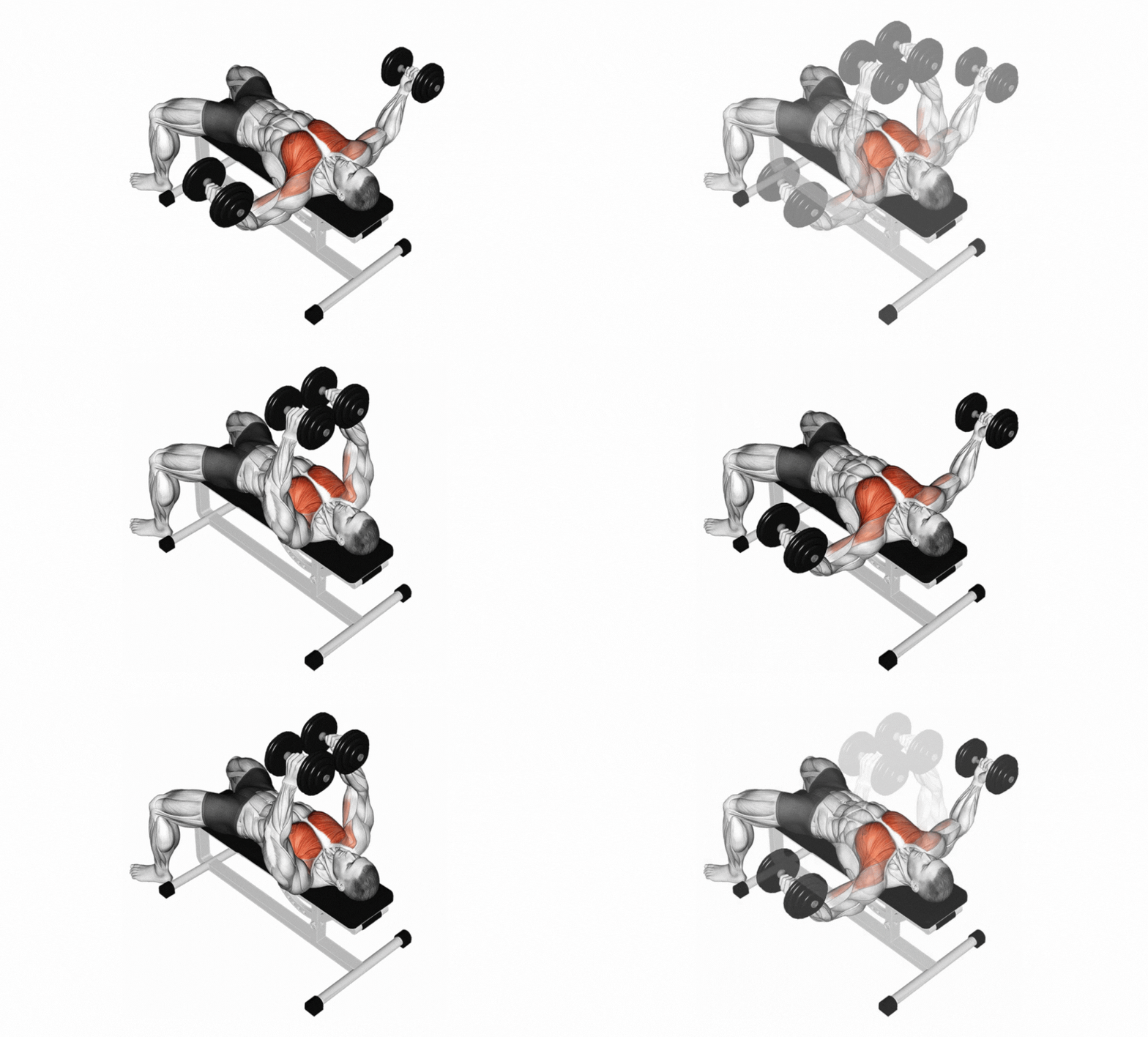
The pectoralis major is the primary muscle worked, particularly its sternocostal portion, which is strongly stretched at the bottom of the movement. The anterior deltoids stabilize the movement. The biceps and forearms hold the dumbbells in position. The upper back ensures scapular stability throughout the exercise.
Pedrosa et al. (2021, European Journal of Sport Science) compared different ranges of motion (full, initial partial in the stretched position, final partial in the contracted position, and varied range) for regional muscle hypertrophy during a strength-training exercise. Their findings show that the group working in the initial partial range — meaning in the stretched portion of the movement — achieved greater hypertrophy gains in certain muscle regions compared with the groups working in the final range (contracted position) or full range of motion. Although this study focuses on knee extension rather than directly on the pectorals, this physiological principle — the value of muscle tension at stretched lengths for hypertrophy — can be applied when considering exercises such as bench flyes, which specifically place the pectoralis major in this stretched zone.
Training a muscle in a stretched position, with a controlled load and constant tension, is a hypertrophy strategy supported by recent research. Bench flyes naturally apply this principle to the pectorals, provided that control is never sacrificed for load.
| Criteria | Bench press | Bench flyes |
|---|---|---|
| Movement type | Compound (pushing) | Single-joint (isolation) |
| Usable load | ✅ High | ⚠️ Moderate to light |
| Triceps involvement | ✅ High | ❌ Very little |
| Pectoral stretch | ⚠️ Moderate | ✅ Maximum |
| Joint risk if performed incorrectly | ⚠️ Moderate | ⚠️ High (shoulder in a stretched position) |
Support your muscle recovery and training intensity with suitable sports nutrition.
Dumbbell bench flyes are an excellent exercise to complement chest training after a compound movement such as the bench press. Their main value lies in the controlled stretch at an extended muscle length, a range that research identifies as particularly favorable for hypertrophy when trained with a manageable load.
Always favor a moderate load, a slow and controlled lowering phase, and constant tension on the pectorals rather than load performance. Find all the supplements selected to support your training at Force Addict Pro.
Retrouvez les réponses aux questions les plus courantes avant votre achat.
Oui, ils contribuent au développement des pectoraux en créant un étirement contrôlé et une contraction ciblée du grand pectoral. Ils sont surtout efficaces placés après un exercice de base comme le développé couché pour ajouter du volume de qualité.
Après, dans la grande majorité des cas. Le développé couché crée la tension mécanique principale. Les écartés viennent ensuite compléter le travail avec plus de contrôle, d'isolation et d'amplitude pour maximiser la congestion et les sensations musculaires.
Une charge modérée permettant de contrôler toute l'amplitude sans douleur. Si vos coudes se plient trop ou si vos épaules prennent le dessus, les haltères sont trop lourds. L'efficacité vient du contrôle et de l'amplitude, pas de la charge.
10 à 15 répétitions sur 3 à 4 séries avec une descente lente de 2 à 3 secondes et un repos de 60 à 90 secondes. Cette fourchette privilégie le temps sous tension, les sensations musculaires et limite le risque de surcharger les épaules.
Pas si l'amplitude est adaptée et la charge raisonnable. Descendez jusqu'à l'étirement confortable, sans douleur articulaire. Gardez les omoplates fixées contre le banc et les coudes légèrement féchis pendant toute la série.
Les haltères offrent un meilleur étirement en bas du mouvement. La poulie maintient une tension plus continue sur toute l'amplitude, particulièrement en haut. Les alterner dans votre programme est une excellente stratégie pour varier le stimulus musculaire.